
The document describes the features and characteristics of the CDC111 1-LINE TO 9-LINE DIFFERENTIAL LVPECL CLOCK DRIVER, including low-output skew, differential low-voltage pseudo-ECL (LVPECL)-compatible inputs and outputs, output reference voltage, and single-ended LVPECL-compatible output enable.
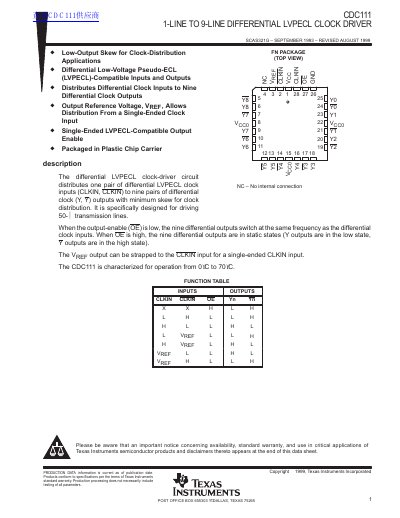
The CDC111 is a differential LVPECL clock driver designed to distribute a single differential clock input to nine differential clock outputs with minimum skew. It is specifically designed for driving 50-Ω transmission lines and features differential LVPECL-compatible inputs and outputs. The device includes an output reference voltage (Vref) that allows distribution from a single-ended clock input and a single-ended LVPECL-compatible output enable.
| Operating temperature | 0°C to 70°C |
|---|---|
| Package type | FN (Plastic Chip Carrier) |
| Number of outputs | 9 differential pairs |
The Vref output can be strapped to the CLKIN input to allow distribution from a single-ended clock input.
The maximum power dissipation at Ta = 55°C in still air is 525 mW.