
The FQP44N10 is a 43.5A, 100V N-channel MOSFET that uses Fairchild's proprietary planar stripe DMOS technology. It has a low on-state resistance, superior switching performance and the ability to withstand high energy pulses in the avalanche and commutation modes. This device is well suited for low voltage applications such as audio amplifiers, high efficiency switching DC/DC converters and DC motor control.
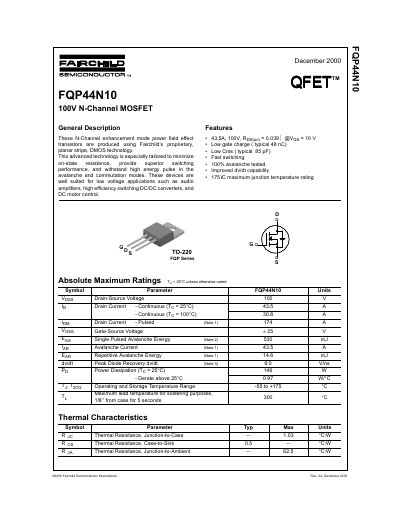
This document is a datasheet for the Fairchild FQP44N10, an N-Channel enhancement mode power field effect transistor. It utilizes Fairchild's proprietary planar stripe DMOS technology to minimize on-state resistance and provide superior switching performance. The device is designed for low voltage applications such as audio amplifiers, high efficiency switching DC/DC converters, and DC motor control.
| Drain-Source Voltage | 100 V |
|---|---|
| Continuous Drain Current (25°C) | 43.5 A |
| On-Resistance | 0.039 ℧ |
| Maximum Junction Temperature | 175°C |
| Package Type | TO-220 |
The device is well suited for low voltage applications such as audio amplifiers, high efficiency switching DC/DC converters, and DC motor control.
The maximum junction temperature rating is 175°C.
Yes, the device is 100% avalanche tested.