
This document introduces the QFET (Qualified Field Engineering Technicians) training program. The QFET training program is designed to help engineers improve their technical skills and knowledge. The program provides engineers with a learning environment in which they can acquire the necessary knowledge and skills to succeed in their careers.
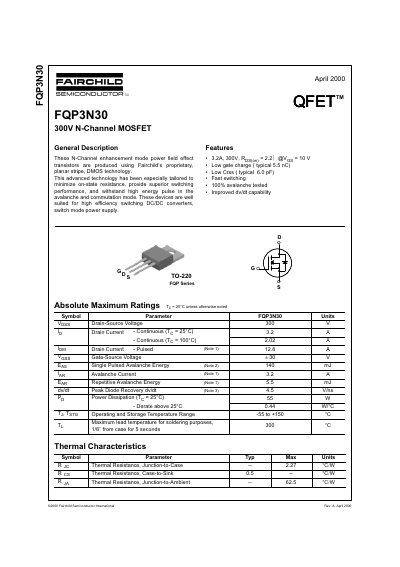
This document is a datasheet for the Fairchild Semiconductor FQP3N30, a 300V N-Channel enhancement mode power field effect transistor. The device utilizes the company's proprietary planar stripe, DMOS technology to minimize on-state resistance and provide superior switching performance. It is well-suited for high efficiency switching DC/DC converters and switch mode power supplies.
| Drain-Source Voltage | 300 V |
|---|---|
| Continuous Drain Current (Tc = 25°C) | 3.2 A |
| Continuous Drain Current (Tc = 100°C) | 2.02 A |
| Pulsed Drain Current | 12.8 A |
| Power Dissipation (Tc = 25°C) | 55 W |
| Operating and Storage Temperature Range | -55 to +150 °C |
| Thermal Resistance, Junction-to-Case | 2.27 °CW |
| Package Type | TO-220 |
The maximum drain-source voltage is 300 V.
The continuous drain current at 25°C is 3.2 A.
The device is packaged in a TO-220 package.