
The four antiarrhythmic drugs, quinidine, disopyramide, procainamide and its metabolite N-acetylprocainamide are separated by HPLC using gradient analysis on a reversed phase column and UV detection. The method is accurate and reliable, and can be used for the determination of these drugs in biological fluids.
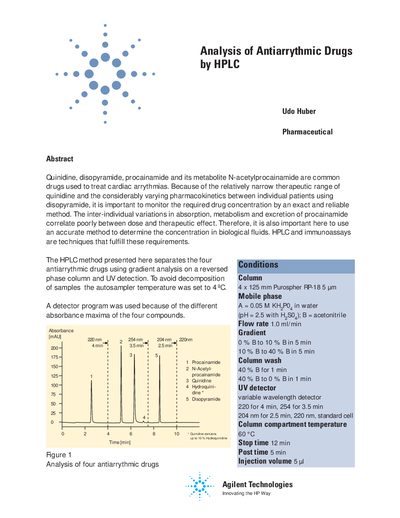
This document presents a High-Performance Liquid Chromatography (HPLC) method for the separation and analysis of four antiarrhythmic drugs: quinidine, disopyramide, procainamide, and N-acetylprocainamide. The method utilizes gradient analysis on a reversed-phase column with UV detection to ensure accurate concentration monitoring in biological fluids.
The procedure is specifically developed for the Agilent 1100 Series HPLC system, which includes a quaternary pump, thermostatted autosampler, thermostatted column compartment, and a variable wavelength detector. The document details the mobile phase composition, gradient program, and equipment requirements, noting that the method may not be reproducible on older or lower-performance systems.
| Column | Purospher RP-18, 5 um, 4x 125 mm |
|---|---|
| Flow rate | 1.0 ml/min |
| Injection volume | 5 ul |
| Autosampler temperature | 4°C |
| Column compartment temperature | Thermostatted |
| Detector | Variable wavelength detector |
| Mobile phase B | Acetonitrile |
The method was specifically developed on the Agilent 1100 Series system.
The drugs are quinidine, disopyramide, procainamide, and N-acetylprocainamide.
The recommended column is Agilent part number 79925PU-564.