
This document describes a GC/MS method using RTL technology that allows for the analysis of 567 of the most common pesticides and endocrine disrupters used worldwide. By utilizing the RTL functionality with the 6890/5973 GC/MSD system, a new database containing mass spectra and compound retention times has been developed. When combined with the compound screening tools in the MSD Productivity ChemStation software, data files can be easily, accurately, and quickly screened for the presence of any of the 567 compounds listed in the database. Additionally, the software features enable the detection of compounds that may usually be masked by others.
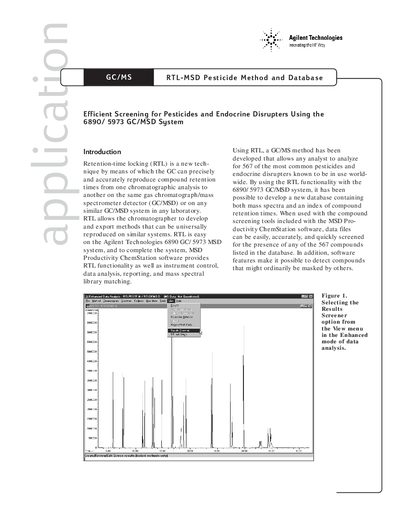
This document introduces a retention-time locking (RTL) technique for the Agilent 6890 GC/5973 MSD system, allowing for the precise reproduction of compound retention times across similar GC/MSD systems. It details a universal method developed to analyze 567 common pesticides and endocrine disrupters worldwide.
| Number of compounds in database | 567 |
|---|---|
| Column type | HP-5 MS column |
| Column dimensions | 30-m, 0.25-mm i.d., 0.250 um thickness |
| Total run time | 41.87 min |
| Locking compound | chlorpyrifos-methyl |
| Locking retention time | 16.596 min |
MSD Productivity ChemStation software provides RTL functionality as well as instrument control, data analysis, reporting, and mass spectral library matching.
Compound matches that are confirmed with high confidence are indicated by an 'X' in the Quick Screener compound results list.
Possible and questionable hits are indicated by a question mark ('?') and suggest that further review of the data is appropriate.