
The document describes two antihypertensive drugs: captopril and enalapril. They lower blood pressure by inhibiting the enzyme that converts angiotensin I into angiotensin II. The document also provides a method for analyzing these two drugs using high-performance liquid chromatography.
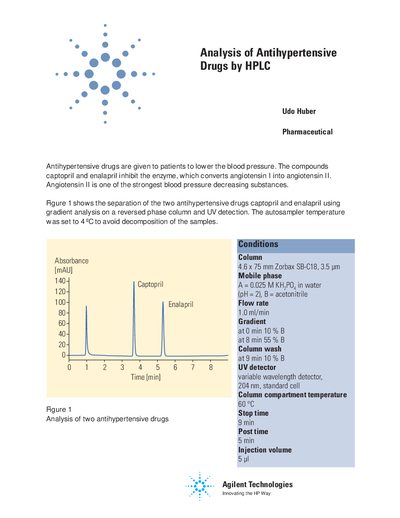
The document presents a High-Performance Liquid Chromatography (HPLC) method for the separation and analysis of two antihypertensive drugs: captopril and enalapril. The method utilizes a Zorbax SB-C18 column and a gradient mobile phase with UV detection at 204 nm. Key operating conditions include an autosampler temperature of 4 °C to prevent sample decomposition and a column compartment temperature of 60 °C.
| Column | Zorbax SB-C18, 3.5 µm |
|---|---|
| Mobile phase A | 0.025 M kH,PO, in water |
| Mobile phase B | acetonitrile |
| Column compartment temperature | 60 °C |
| UV detector wavelength | 204 nm |
| Injection volume | 5 ul |
| Autosampler temperature | 4 °C |
The method analyzes captopril and enalapril.
It is set to avoid decomposition of the samples.
The Zorbax SB-C18, 3.5 µm column is used.