
The document describes the analysis of tricyclic antidepressant drugs. Tricyclic antidepressants are tricyclic derivatives of diphenylamine or diphenylmethane and have mood-enhancing effects. Antidepressants inhibit the mechanism that inactivates these amines, resulting in a higher concentration at the corresponding receptors. They have parasympatholytic side effects that occur a few days after treatment. The desired antidepressant effects occur after two to three weeks.
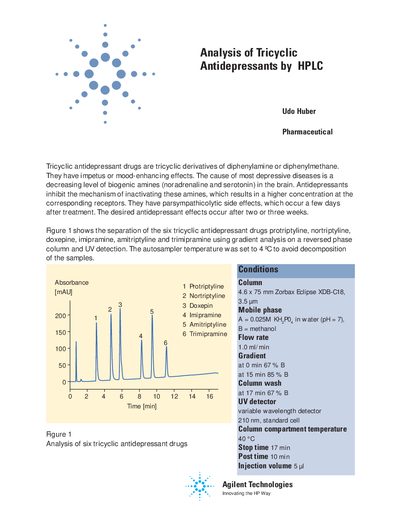
The document presents a high-performance liquid chromatography (HPLC) method for separating and quantifying six specific tricyclic antidepressant drugs: protriptyline, nortriptyline, doxepine, imipramine, amitriptyline, and trimipramine. The analysis utilizes gradient elution on a reversed-phase column with UV detection at 210 nm.
| Column dimensions | 4.6 x 75 mm |
|---|---|
| Particle size | 3.5 um |
| Mobile phase A | 0.025M KH2PO4 in water (pH = 7) |
| Mobile phase B | methanol |
| Flow rate | 1.0 ml/min |
| UV detection wavelength | 210 nm |
| Column temperature | 40°C |
The method analyzes protriptyline, nortriptyline, doxepine, imipramine, amitriptyline and trimipramine.
The method was developed on the Agilent 1100 Series system including a quaternary pump, thermostatted autosampler, column compartment, and variable wavelength detector.
The recommended injection volume for this method is 5 ul.