
The document describes the HPLC analysis method for quinine and quinidine in cinchona bark extract. The cinchona bark contains 4-12% alkaloids, mainly the diastereomers quinine/quinidine and cinchonine/cinchonidine. Quinine is the major compound accounting for 80% of the total alkaloids in cinchona bark. It is a strong protoplasmic poison with effects on almost any cell. Quinine is used as an anti-malaria medicine. Some soft drinks, such as tonic water, contain up to 80 mg/l of quinine, which gives them a bitter taste.
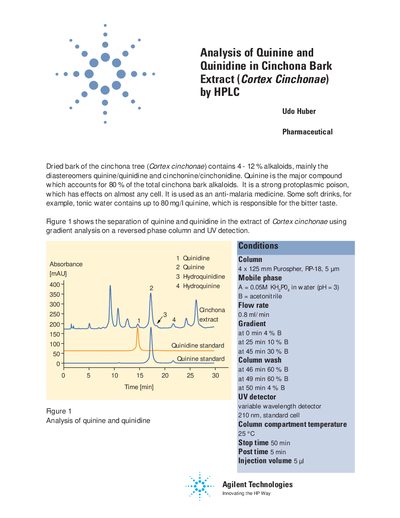
The document details a High-Performance Liquid Chromatography (HPLC) method developed by Udo Huber to analyze quinine and quinidine in Cinchona Bark Extract (Cortex Cinchonae). The method utilizes gradient analysis on a reversed phase column with UV detection at 210 nm. It highlights that the extract contains alkaloids, primarily diastereomers of quinine/quinidine and cinchonine/cinchonidine, with quinine being the major compound accounting for approximately 80% of total alkaloids.
| Column | 4 x 125 mm Purospher, RP-18, 5 um |
|---|---|
| Mobile phase A | 0.05M KH,P9, in water (pH = 3) |
| Mobile phase B | acetonitrile |
| Flow rate | 0.8 ml/min |
| UV detector wavelength | 210 nm, standard cell |
| Column compartment temperature | 25°C |
| Injection volume | 5 ul |
The method uses an Agilent 1100 Series system including a quaternary pump, thermostatted autosampler, thermostatted column compartment, and variable wavelength detector.
No, the method was specifically developed on the Agilent 1100 Series system and might not be reproducible on an older system or a new system with lower performance.
The recommended guard cartridge is Purospher RP-18, 5 um, 4x 4mm with Agilent part number 79925PU-504.