
Electron capture negative chemical ionization mass spectrometry is used to analyze cannabinoids in biological matrices.
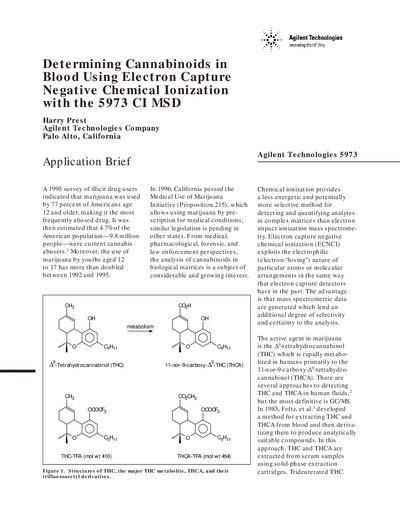
This document details a method for analyzing cannabinoids in biological matrices, specifically blood, using the Agilent 5973 CI MSD. The technique utilizes Electron Capture Negative Chemical Ionization (ECNCI) to detect and quantify Delta-9-tetrahydrocannabinol (THC) and its metabolite, 11-nor-9-carboxy-Delta-9-tetrahydrocannabinol (THCA). The method involves extracting these compounds from serum samples, derivatizing them to trifluoroacetyl derivatives (THC-TFA and THCA-TFA), and analyzing them via Gas Chromatography/Mass Spectrometry (GC/MS). The use of deuterated surrogates allows for accurate quantification with detection limits below 0.5 ng/mL.
| Detection Limit | below 0.5 ng/mL |
|---|---|
| Molecular Weight THC-TFA | 410 amu |
| Molecular Weight THCA-TFA | 454 amu |
| Source Temperature | 150°C |
| Quadrupole Temperature | 106°C |
| EM Voltage | 1800 Volts |
| Carrier Gas | Helium |
The trifluoroacetyl derivative of THC (THC-TFA) has a molecular weight of 410 amu, and THCA-TFA has a molecular weight of 454 amu.
The analysis uses Electron Capture Negative Chemical Ionization (ECNCI).