
This document introduces the detailed steps for analyzing testosterone and its metabolites using HPLC.
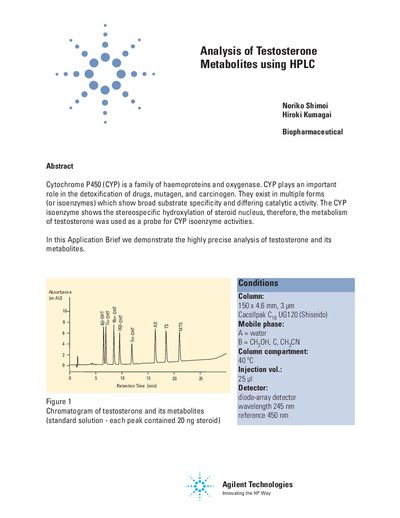
This document presents an application brief for the analysis of testosterone and its metabolites using High-Performance Liquid Chromatography (HPLC). The method utilizes a Cytochrome P450 (CYP) isoenzyme probe to demonstrate the capabilities of the system in detecting steroid compounds with high precision.
| Column | 150 x 4.6 mm, 3 um |
|---|---|
| Mobile phase A | water |
| Column compartment temperature | 40 C |
| Detector | diode-array detector |
| Wavelength | 245 nm |
| Limit of detection | 0.18 - 1.33 ng |
The system utilizes Agilent ChemStation software for data acquisition and analysis.
The limit of detection ranges from 0.18 to 1.33 ng with a signal-to-noise ratio of 3.