
This article describes the use of high-performance liquid chromatography (HPLC) for the analysis of fat-soluble vitamins. HPLC can separate and detect these compounds at room temperature while blocking oxygen and light. UV-visible diode-array detection provides both qualitative and quantitative data. Electrochemical detection is also a highly sensitive and selective HPLC method. Different food matrices require different extraction procedures, including alkaline hydrolysis, enzymatic hydrolysis, alcoholysis, direct solvent extraction, and supercritical fluid extraction.
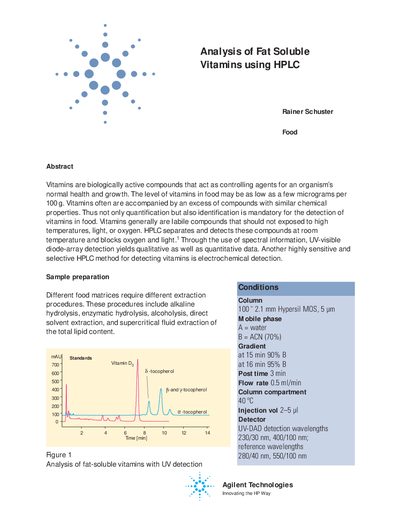
The document presents a High-Performance Liquid Chromatography (HPLC) method for analyzing fat-soluble vitamins in food matrices. It emphasizes that quantification must be accompanied by identification due to the presence of interfering compounds with similar chemical properties. The method utilizes UV-visible diode-array detection and electrochemical detection, operating at room temperature while blocking oxygen and light to protect labile vitamin compounds.
| Column type | 100 x 2.1 mm Hypersil MOS, 5 um |
|---|---|
| Mobile phase B | ACN (70%) |
| Flow rate | 0.5 ml/min |
| Column temperature | 30°C |
| Injection volume | 2—5 ul |
| Detection wavelengths | 230/30 nm, 400/100 nm; reference 280/40 nm, 550/100 nm |
| Limit of detection | 1 ppb with S/N =2 |
The system includes a vacuum degasser, quaternary pump, autosampler, thermostatted column compartment, and diode array detector.
The method utilizes Agilent ChemStation software.