
Agilent 1100 Series LC Analysis of Beta-Blocking Drugs Application Note

This article compares the detection techniques UV, fluorescence, and mass spectrometry in combination with standard and capillary LC systems and columns with different internal diameters. The advantages and disadvantages of the different detector/column/LC system combinations are discussed.
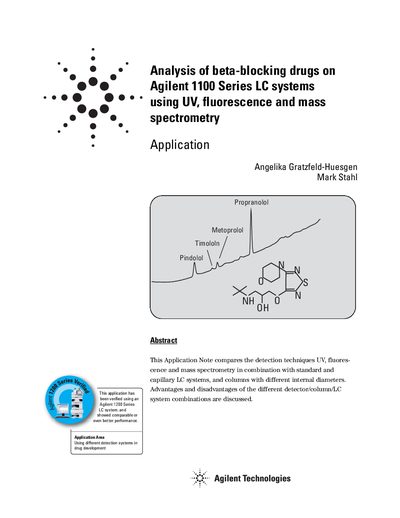

Agilent 1100 Series LC Analysis of Beta-Blocking Drugs Application Note - cover page
Brand
Agilent
Document type
Application Note
Language
English
Pages
8
File format
PDF
File size
143 KB
Published
02 July, 2012
Updated
29 September, 2023
MD5 checksum
859D4C8F807A056DF5368EC561A08A06

About this manual

This document evaluates the performance of different detection methods—UV, fluorescence, and mass spectrometry (MS)—when combined with standard and capillary Liquid Chromatography (LC) systems from the Agilent 1100 Series. The study focuses on determining the limit of detection for four specific beta-blocking drugs: Pindolol, Timolol, Metoprolol, and Propranolol.

What's inside

  • Introduction
  • Experimental Setup
  • Limit of Detection using UV Detection
  • Limit of Detection using Fluorescence Detection
  • Limit of Detection using MSD Quadrupole
  • Chromatographic Conditions

Frequently asked questions

Which beta-blocking drugs were analyzed in this study?

The analysis included Pindolol, Timolol, Metoprolol, and Propranolol.

What is the limit of detection for Propranolol using fluorescence detection?

The limit of detection for Propranolol using fluorescence detection is about 120 pg.

Download PDF (143 KB)

More Agilent Manuals


View all Agilent manuals →