
This Application Note describes how a S9 human liver homogenate was used to simulate oxidative phase 1 metabolism of the beta-blocking drugs propranolol, metoprolol and pindolol. Afterwards, the samples were partially purified by precipitation/extraction with trifluoroacetic acid and hexane, followed by analysis with an Agilent 1100 Series LC/MSD trap XCT system. Fully automated LC/MS and LC/MSn analysis allowed for identification of the metabolites produced by the liver homogenate.
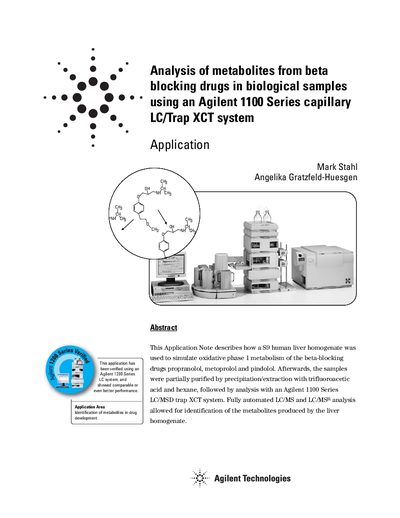
This document describes an application using an Agilent 1100 Series capillary LC/Trap XCT system to analyze metabolites from beta-blocking drugs in biological samples. The study utilized a human liver homogenate to simulate oxidative phase 1 metabolism of propranolol, metoprolol, and pindolol. Samples were prepared via precipitation/extraction with trifluoroacetic acid and hexane before analysis.
The analysis identified specific metabolites, including o-hydroxy-metoprolol, o-desmethyl-metoprolol, and hydroxylated forms of propranolol and pindolol. The note details the chromatographic conditions, such as the use of a ZORBAX SB C18 column and a gradient of water and acetonitrile, as well as the mass spectrometry parameters for the XCT ion trap.
| Mobile phase A | water (0.1 % formic acid) |
|---|---|
| Mobile phase B | acetonitril (0.1 % formic acid) |
| Flow rate | 4 l/min |
| Capillary voltage | 4000 V |
| Drying gas flow | 4 L/min |
| Drying gas temp | 320 °C |
| MS Scanrange | 150-1500 Da |
The final assay concentration was 1 pg/mL.
The assay was incubated for 35 hours.
The flow rate is 4 l/min.