
In this Application Note, the Agilent 6140 quadrupole LC/MS and Agilent 1200 Series Rapid Resolution LC systems are combined to demonstrate the need for a fast-scanning, quadrupole MS detector, fast positive/negative switching, and uncompromised MS spectra quality in ultra-fast-scanning mode. The source of peak broadening of the MS peaks is explained and several application examples are given.
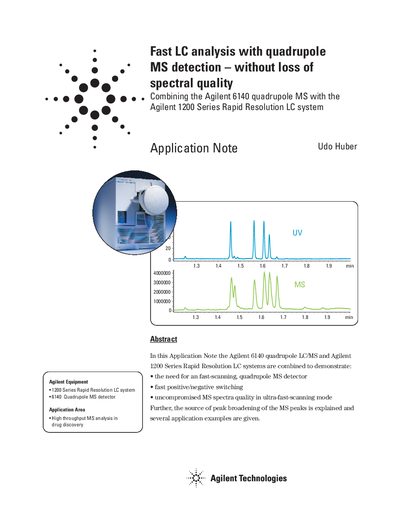
This document describes a combination of the Agilent 6140 quadrupole MS and the Agilent 1200 Series Rapid Resolution LC (RRLC) system. It demonstrates that the 6140 model, designed for ultra-fast scan speeds up to 10000 amu/second, is necessary to keep pace with fast chromatography runs of two minutes or less while maintaining high-quality spectral data.
In ultra-fast scan mode, about 20 scans per second can be achieved.
The delay required for the polarity switching is 20 ms.
70% of the peak broadening is caused by dispersion in the UV detector flow cell and tubing, while only 30% comes from the MS itself.