
Effect of Nonvolatile Buffers on the Agilent 1100 Series LC/MSD Application Note

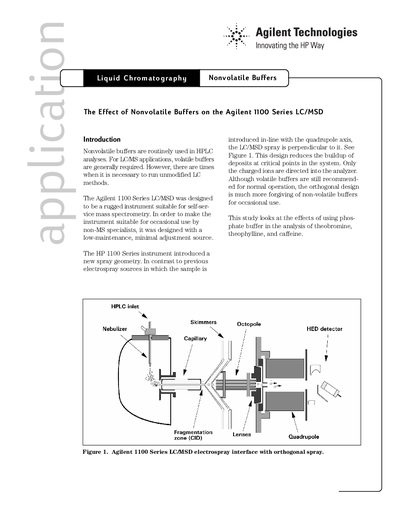
This document introduces the characteristics of the Agilent 1100 Series LC/MSD electrospray interface, including system composition, working principle, application range, etc.

Effect of Nonvolatile Buffers on the Agilent 1100 Series LC/MSD Application Note - cover page
Brand
Agilent
Document type
Application Note
Language
English
Pages
6
File format
PDF
File size
448 KB
Published
02 July, 2012
Updated
30 September, 2023
MD5 checksum
CCA580406DEA9E3AB994F4207DEEF4C6

About this manual

The document investigates how nonvolatile buffers, specifically potassium phosphate at different pH levels, affect the performance of the Agilent 1100 Series LC/MSD. It compares signal response and spectral integrity against volatile ammonium acetate buffers using test compounds like theobromine, theophylline, and caffeine.

What's inside

  • Introduction
  • Chromatographic Conditions
  • MS Conditions
  • Results and discussion
  • Signal response comparison
  • Spectral integrity

Frequently asked questions

What compounds were used to test the effect of nonvolatile buffers?

The study analyzed theobromine, theophylline, and caffeine.

What is the flow rate used for the chromatographic conditions?

The system operates with a flow rate of 0.2 ml/min.

How many times were the test compounds injected over the testing period?

The test compounds in phosphate buffer were injected 100 times over 16 hours.

Download PDF (448 KB)

More Agilent Manuals


View all Agilent manuals →