
This Application Note describes the experimental details and results of a plasma protein binding (PPB) assay. The approach and methodology of rapid resolution liquid chromatography and triple quadrupole mass spectrometry used in this study are described in a separate Application Note1. Experimental details and results of other typical assays per- formed in early ADME profiling of new hits are presented in separate publications2,3.
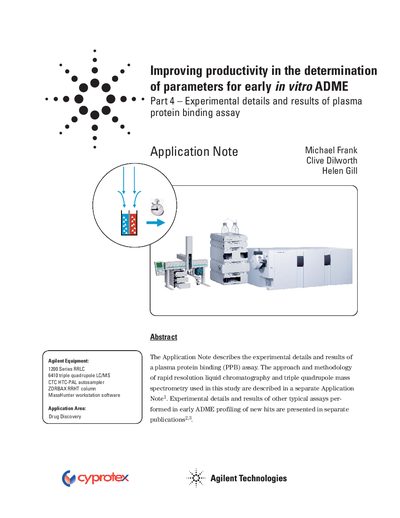
This document describes the experimental details and results of a plasma protein binding (PPB) assay designed for early in vitro ADME profiling. The study utilizes Agilent's rapid resolution liquid chromatography (RRLC) and triple quadrupole mass spectrometry (LC/MS/MS) systems, specifically the 1200 Series RRLC, 6410 triple quadrupole LC/MS, CTC HTC-PAL autosampler, and ZORBAX RRHT column.
The note outlines the equilibrium dialysis protocol, including sample preparation, incubation conditions, and the specific MRM method setup for various test compounds. It presents a summary of results showing the fraction unbound and recovery percentages for several compounds in human plasma.
| Test compound summary concentration | 5 uM |
|---|---|
| Final DMSO concentration | 0.5 % |
| Final ISTD concentration | 0.18 pM |
| Plasma type | Human |
| Phosphate buffer concentration | 0.1 M |
| Incubation temperature | 37°C |
| Incubation time | overnight |
| Final Volume | 130 pl |
| Centrifugation temperature | 4 °C |
The study uses Agilent Equipment: 1200 Series RRLC, 6410 triple quadrupole LC/MS, CTC HTC-PAL autosampler, ZORBAX RRHT column, and MassHunter workstation software.
The incubation temperature was set to 37°C.
Metoprolol was used as the internal standard (ISTD).
The final volume for the assay was 130 pl.