
The method used SDB-RPS disk and FMOC for the detection of anatoxin-a. The recovery rate was 97.6%-102.1% at 10 ng/L, and the detection limit was 0.8 ng/L.
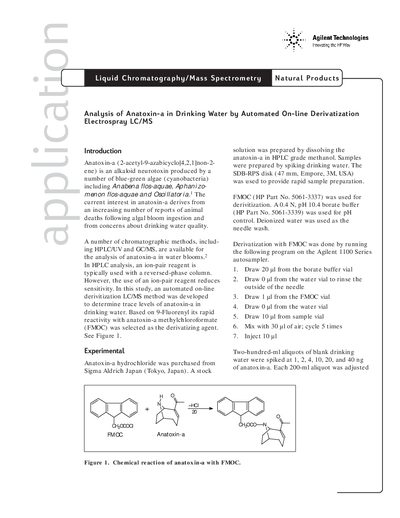
The document details a method developed to determine trace levels of anatoxin-a in drinking water. It addresses the limitations of standard HPLC/UV methods, which require ion-pair reagents that reduce sensitivity. The proposed method uses 9-Fluorenylmethyl chloroformate (FMOC) as a derivatizing agent, selected for its rapid reactivity with anatoxin-a.
| Detection Limit | below 10 pg/ml |
|---|---|
| Column | Inertsil ODS3 {5um, 150 mm, 2.1 mm} |
| Column Temp | 40°C |
| Flow rate | 0.2 ml/min |
| Injection vol | 10 ul |
| Veap | 4000 V |
| Drying gas temp | 350°C |
| Fragmentor | 100 V |
9-Fluorenylmethyl chloroformate (FMOC) was selected as the derivatizing agent.
The method provides a detection limit below 10 pg/ml.
The calibration curve shows a good correlation coefficient of R² = 0.998.