
This Application Note describes the experimental details and results of a Caco-2 permeability (Caco-2) assay. The approach and methodology of rapid resolution liquid chromatography and triple quadrupole mass spectrometry used in this study are described in a separate Application Note1. Experimental details and results of other typical assays performed in early ADME profiling of new hits are presented in separate publications,2,3. Improving productivity in the determination of parameters for early in vitro ADME Part 3 – Experimental details and results of Caco-2 permeability assay.
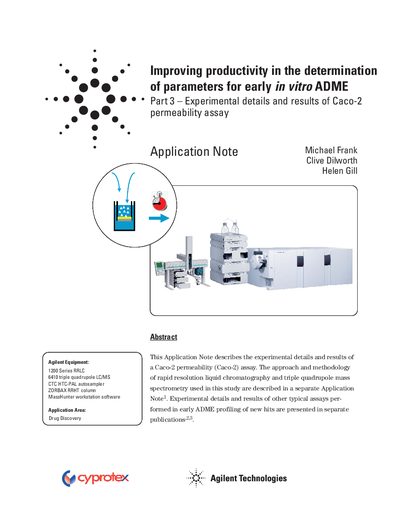
This document describes an early in vitro ADME profiling study focusing on the Caco-2 permeability assay. It outlines the specific experimental details involving Agilent Equipment, including the 1200 Series RRLC system, a CTC HTC-PAL autosampler, and MassHunter workstation software for data analysis.
The note presents a summary of the final test compound protocol, detailing cell culture conditions (ATCC Caco-2 cells), buffer composition (HBSS with HEPES and glucose), and incubation parameters. It also provides a table of MRM method setups for various compounds and summarizes the resulting apparent permeability (Papp) values and recovery percentages.
The final concentration for the test compound is 10 uM.
The final DMSO concentration must be 1.0%.