
This document describes the separation performance of Agilent ZORBAX 300 SB-C8 for complex plant protein samples, and the effect of temperature in reverse phase separations of complex samples.
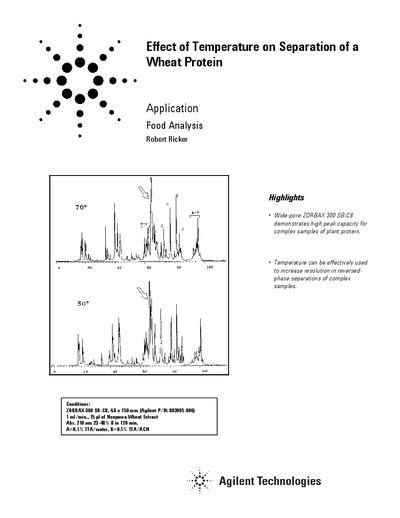
This document describes an application for food analysis involving the separation of complex plant protein samples. It highlights that wide-pore ZORBAX 300 SB-C8 columns demonstrate high peak capacity and that temperature can be effectively used to increase resolution in reversed-phase separations.
The note provides specific experimental conditions, including a column size of 4.6 x 150 mm (Agilent P/N: 883995-906), a flow rate of 1 ml/min., and an injection volume of 15 pl of Neepawa Wheat Extract. The separation was monitored at Absorbance 210 nm with a gradient from 23% to 48% B over 120 minutes, where A is 0.1% TFA/water and B is 0.1% TFA/ACN.
The procedure uses a Wide-pore ZORBAX 300 SB-C8 column.
Temperature can be effectively used to increase resolution in reversed-phase separations.