
This document discusses the effect of mobile-phase solvent strength in the separation of mono- and disaccharides. Good resolution of various sugars can be achieved using a ZORBAX NH2 column. The retention of sugars increases with increasing organic content in the mobile phase.
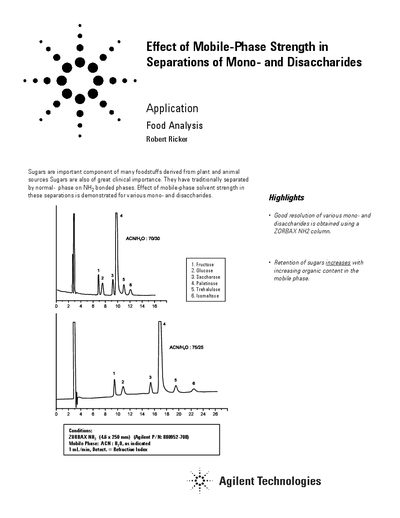
Sugars are important components of foodstuffs derived from plant and animal sources and hold great clinical importance. This document demonstrates how to separate these sugars, which have traditionally been separated by normal-phase chromatography on NH2 bonded phases.
The application highlights that good resolution of various mono- and disaccharides is obtained using a ZORBAX NH2 column. It further notes that the retention of sugars increases with increasing organic content in the mobile phase.
The separation uses a ZORBAX NH2 column.
Retention of sugars increases with increasing organic content in the mobile phase.
The flow rate is set to 1 mL/min.