
This application note describes a method for the high-sensitivity analysis of betaine in Chinese lycium using high-performance liquid chromatography (HPLC) with an electrochemical detection (ELSD). This method has high sensitivity and is suitable for the determination of betaine in plasma and other biological samples.
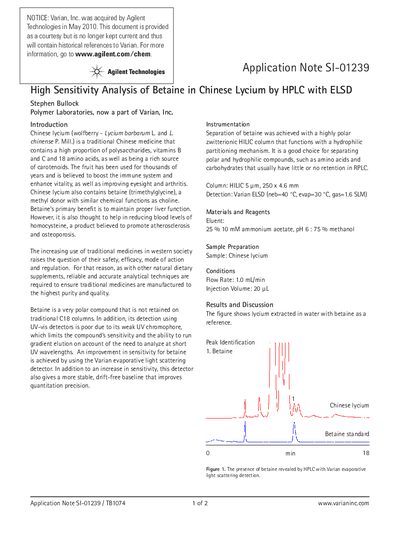
Chinese lycium is a traditional medicine containing betaine, a polar compound difficult to detect with standard UV detectors. This document presents an analytical method using highly polar zwitterionic HILIC columns combined with Varian evaporative light scattering (ELSD) detection to achieve high sensitivity and stable baselines for quantifying betaine.
The procedure utilizes a mobile phase of 25% ammonium acetate in methanol, a flow rate of 1.0 mL/min, and an injection volume of 20 µL. The ELSD is operated with a nebulizer temperature of 40 °C, evaporation temperature of 30 °C, and gas flow of 1.6 SLM.
| Column Type | HILIC 5 µm, 250 x 4.6 mm |
|---|---|
| Detection Method | Varian ELSD |
| Eluent Composition | 25 % 10 mM ammonium acetate, pH 6 : 75 % methanol |
| Flow Rate | 1.0 mL/min |
| Injection Volume | 20 µL |
ELSD is the preferred technique because it detects compounds that possess a weak or no UV chromophore, unlike standard UV detectors.
A highly polar zwitterionic HILIC column functioning with a hydrophilic partitioning mechanism is used.