
This document describes the application of Varian's HPLC (High Performance Liquid Chromatography) products in the determination of glutamic acid. Glutamic acid is a common natural amino acid that is critical for cell function and is one of the building blocks in protein synthesis. The document discusses the importance of glutamic acid in protein synthesis and brain function, as well as the role of glutamic acid salt (MSG) in human taste perception.
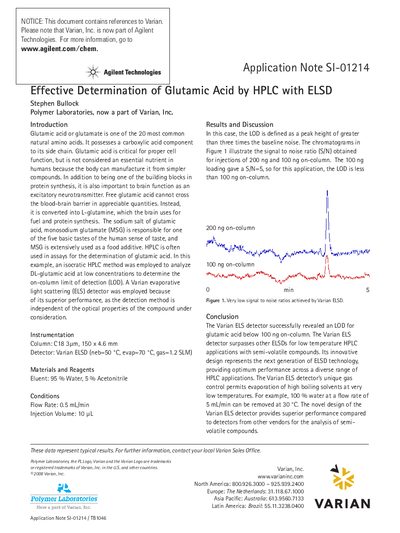
This document presents an analytical method for determining glutamic acid using High-Performance Liquid Chromatography (HPLC) coupled with an evaporative light scattering detector (ELSD). The study focuses on analyzing DL-glutamic acid at low concentrations to establish the on-column limit of detection (LOD).
The methodology employs a C18 column and a Varian ELSD detector configured with specific nebulization, evaporation, and gas flow parameters. Results indicate that the LOD is less than 100 ng on-column, demonstrating the detector's superior performance for semi-volatile compounds in low-temperature HPLC applications.
The limit of detection is less than 100 ng on-column.
The flow rate is 0.5 mL/min.
The injection volume is 10 LL.