
This application note describes the analysis of complex triglycerides in borage oil using LC-ELSD.
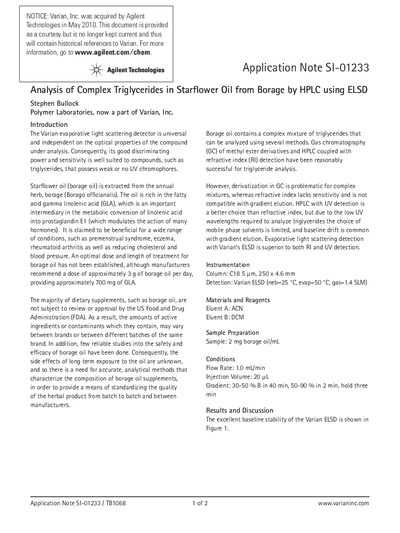
This document details an analytical method for determining the composition of triglycerides in starflower oil (borage oil) using High-Performance Liquid Chromatography (HPLC) coupled with an evaporative light scattering detector (ELSD). The text explains that the Varian ELSD is superior to UV or refractive index detection for this application because it is universal and independent of the optical properties of the compounds, making it suitable for triglycerides which possess weak or no UV chromophores.
The note provides specific instrumentation and method parameters, including a C18 column, mobile phases of acetonitrile and dichloromethane, and a specific gradient elution profile. It presents results showing the separation of various triglycerides and concludes that the Varian ELSD offers excellent baseline stability and superior performance for analyzing semi-volatile compounds in low-temperature HPLC applications.
| Column | C18 5 um, 250 x 4.6 mm |
|---|---|
| Detection Neb Temperature | 25 °C |
| Detection Evaporation Temperature | 50 °C |
| Flow Rate | 1.0 mL/min |
| Injection Volume | 20 wL |
ELSD is superior because it is universal and independent of the optical properties of the compound, whereas UV detection requires low wavelengths that limit solvent choices and cause baseline drift.
The eluents used are Acetonitrile (ACN) for Eluent A and Dichloromethane (DCM) for Eluent B.