
This document describes a method for the rapid identification of illegal dyes in paprika oil using HPLC with ELSD technology. Sudan dyes I-IV, which are categorized as class 3 carcinogens by the International Agency for Research on Cancer, are not approved for use in food products. The document also discusses the characteristics of Sudan dyes and regulatory requirements.
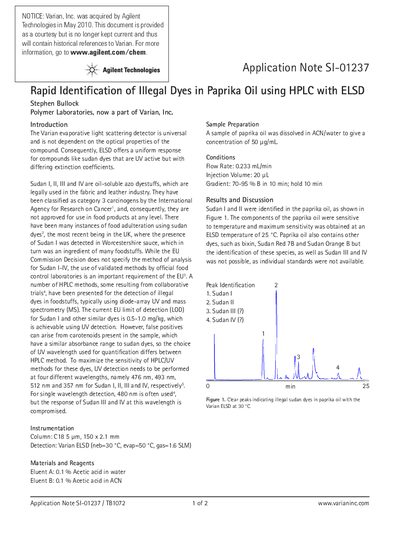
The document presents an Application Note detailing the use of High-Performance Liquid Chromatography (HPLC) combined with an Evaporative Light Scattering Detector (ELSD) to identify illegal Sudan dyes in food products. Specifically, it focuses on detecting Sudan I and II in paprika oil samples.
The note outlines the instrumentation used, including a C18 column and specific ELSD settings (neb=30 °C, evap=50 °C). It details the sample preparation involving acetonitrile/water dissolution and provides chromatographic conditions such as flow rate, injection volume, and gradient elution. The results confirm the presence of Sudan I and II in the tested paprika oil.
The components of the paprika oil were sensitive to temperature and maximum sensitivity was obtained at an ELSD temperature of 25 °C.
The flow rate specified for the analysis conditions is 0.233 mL/min.
The procedure requires an injection volume of 20 wL.