
Application Note SI-01229 introduces the benefits of using a low-temperature ELSD for the analysis of herbicides by HPLC.
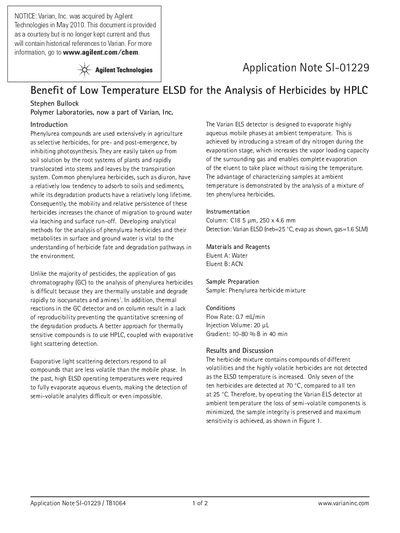
This document describes an analytical method using High-Performance Liquid Chromatography (HPLC) coupled with an evaporative light scattering detector (ELSD) to analyze phenylurea herbicides. It highlights the challenges of analyzing these compounds due to their thermal instability and the limitations of gas chromatography (GC). The note specifically addresses the difficulty of detecting semi-volatile analytes when using traditional ELSDs that require high operating temperatures to evaporate aqueous mobile phases.
| Column | C18 5 um, 250 x 4.6 mm |
|---|---|
| Detection Nebulizer Temperature | 25 °C |
| Detection Evaporation Gas Flow | 1.6 SLM |
| Flow Rate | 0.7 mL/min |
| Injection Volume | 20 wL |
| Gradient | 10-80 % B in 40 min |
Operating the detector at ambient temperature minimizes the loss of semi-volatile components, preserves sample integrity, and achieves maximum sensitivity.
All ten herbicides were detected at 25°C, whereas only seven were detected at 70°C.