
This document describes the application of GC/MS analysis of brominated diphenylethers and brominated biphenyls (flame retardants) following ROHS guideline. It includes information on the technique, instrument setup, sample preparation, and peak identification.
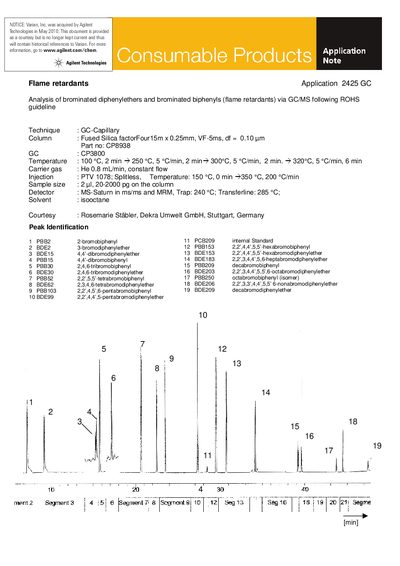
This document provides a method for analyzing flame retardants, specifically brominated diphenylethers (BDE) and brominated biphenyls (PBB), via GC/MS. The procedure follows the RoHS guideline and utilizes an Agilent CP3800 gas chromatograph with a Saturn mass spectrometer detector.
The method employs a fused silica capillary column (VF-5ms) and helium as the carrier gas. Key parameters include a specific temperature program starting at 100°C, PTV injection settings, and MS detection in both full scan and MRM modes to identify various brominated compounds.
| Column Type | Fused Silica factorFour15m x 0.25mm, VF-5ms, df = 0.10 um |
|---|---|
| GC Model | CP3800 |
| Detector Type | MS-Saturn in ms/ms and MRM |
| Carrier Gas | He 0.8 mL/min, constant flow |
| Injection Mode | PTV 1078; Splitless |
| Sample Size | 2 ul, 20-2000 pg on the column |
The analysis covers brominated diphenylethers (BDE) and brominated biphenyls (PBB).
The analysis follows the RoHS guideline.
The detector operates in ms/ms and MRM modes with a trap temperature of 240 °C.