
This article introduces the method of HPLC detection of caffeine using a Varian ELSD detector. A gradient HPLC method was used to analyze caffeine at low concentrations to determine the on-column limit of detection (LOD).
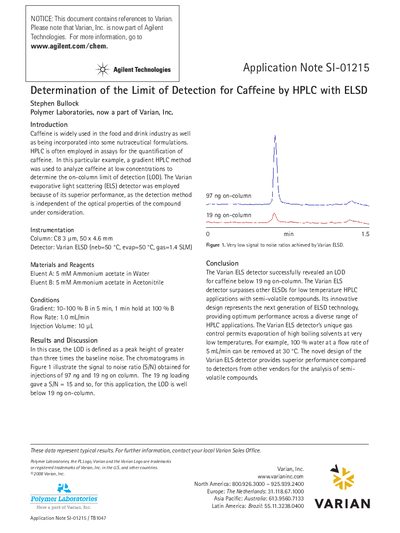
This document presents an application note detailing the determination of the limit of detection (LOD) for caffeine using High-Performance Liquid Chromatography (HPLC) coupled with an evaporative light scattering detector (ELSD). The method utilizes a gradient HPLC setup to analyze caffeine at low concentrations, demonstrating the detector's capability to achieve a signal-to-noise ratio sufficient for detection below 19 ng on-column.
| Column | C8 3 um, 50x 4.6 mm |
|---|---|
| Detector Neb Temperature | 50 °C |
| Detector Evap Temperature | 50 °C |
| Detector Gas Flow | 1.4 SLM |
| Eluent A | 5 mM Ammonium acetate in Water |
| Eluent B | 5 mM Ammonium acetate in Acetonitrile |
| Gradient | 10-100 % B in 5 min, 1 min hold at 100 % B |
| Flow Rate | 1.0 mL/min |
| Injection Volume | 10 LL |
The LOD is well below 19 ng on-column, as a 19 ng loading gave a signal-to-noise ratio of 15.
The LOD is defined as a peak height of greater than three times the baseline noise.