
This paper describes maximum sensitivity in the analysis of parabens using low temperature ELSD.
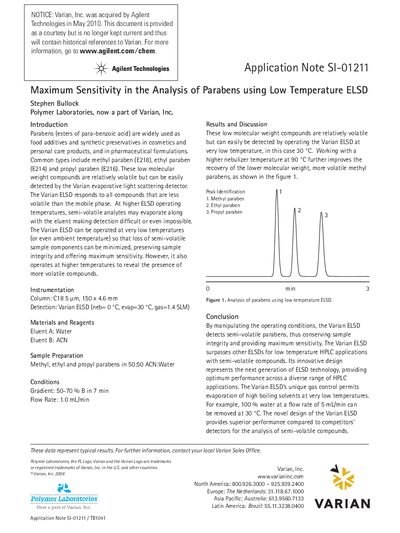
This document details a method for analyzing parabens (methyl, ethyl, and propyl) using an evaporative light scattering detector (ELSD). It highlights that while these compounds are relatively volatile, they can be effectively detected by operating the ELSD at very low temperatures, such as 30 °C, to prevent sample loss and preserve integrity. The note explains that higher temperatures can cause semi-volatile analytes to evaporate along with the eluent, making detection difficult.
| Column | C18 5 wm, 150 x 4.6 mm |
|---|---|
| Evaporator Temperature | 30 °C |
| Gas Flow Rate | 1.4 SLM |
| Flow Rate | 1.0 mL/min |
The document recommends operating the ELSD at very low temperatures, specifically 30 °C, to minimize the loss of semi-volatile sample components.
Yes, the ELSD can detect semi-volatile parabens at low temperatures, and higher nebulizer temperatures can further improve the recovery of lower molecular weight, more volatile methyl parabens.