
This article describes the effective analysis of low chromophore polymer additives using HPLC with ELSD. ELSD is a detection technique that is suitable for compounds with weak or no UV chromophores. The article mentions that Varian's evaporative light scattering detector is highly sensitive to a wide range of compounds and is ideal for this application. Analysis of polymer additives has been limited by the suitability of the detection method, as many additives lack a UV chromophore and are not suitable for refractive index detection. Therefore, there is a need for accurate, reliable, and robust analytical methods. The article also discusses the importance of polymer additives in polymers and their impact on polymer characteristics.
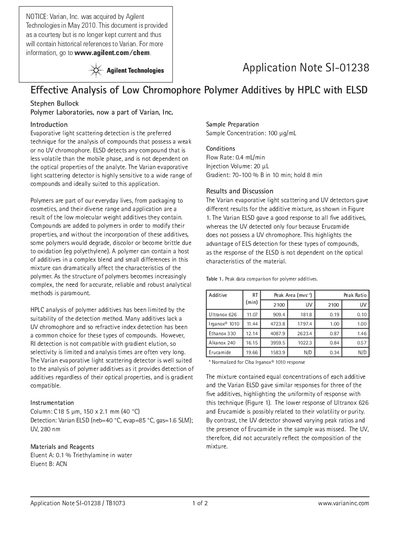
This document describes an application note detailing the analysis of low chromophore polymer additives using High-Performance Liquid Chromatography (HPLC) coupled with an Evaporative Light Scattering Detector (ELSD). The text explains that ELSD is the preferred technique for compounds lacking UV chromophores, as it detects any compound less volatile than the mobile phase without dependence on optical properties. It highlights the limitations of Refractive Index (RI) detection regarding gradient elution and long analysis times.
| Column | C18 5 µm, 150 x 2.1 mm |
|---|---|
| Detection Nebulizer Temperature | 40 °C |
| Detection Evaporator Temperature | 85 °C |
| Detection Gas Flow | 1.6 SLM |
| UV Wavelength | 280 nm |
| Eluent A | 0.1 % Triethylamine in water |
| Eluent B | ACN |
| Sample Concentration | 100 pg/mL |
| Flow Rate | 0.4 mL/min |
| Injection Volume | 20 µL |
| Gradient | 70-100 % Bin 10 min; hold 8 min |
ELSD is preferred because it detects compounds regardless of their optical properties, whereas UV detection may miss additives like Erucamide that lack a UV chromophore.
RI detection is not compatible with gradient elution, which limits selectivity and often results in very long analysis times.