
Varian Application Note SI-01228 Single Run Analysis of St John's Wort Tablets by HPLC with ELSD

This is an application note on the HPLC analysis of St John's Wort tablets. The herb contains complex chemicals, including hypericin and hyperforin. This article discusses the uses of the product, its chemical components, and the importance of monitoring and characterization.
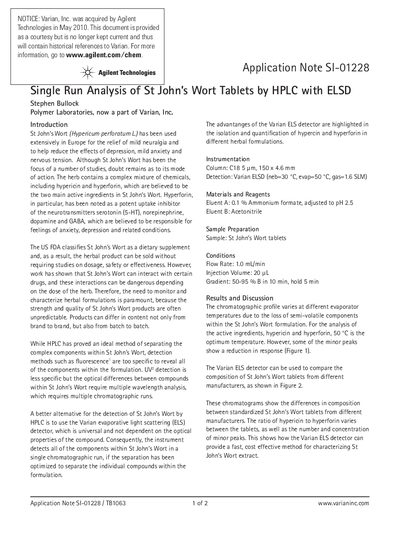

Varian Application Note SI-01228 Single Run Analysis of St John's Wort Tablets by HPLC with ELSD - cover page
Brand
Agilent
Document type
Application Note
Language
English
Pages
2
File format
PDF
File size
201 KB
Published
12 June, 2012
Updated
29 September, 2023
MD5 checksum
84DDEC03FB286D160EC0D7F03FD4315A

About this manual

St. John's Wort contains complex mixtures of chemicals, including hypericin and hyperforin, which are believed to be the main active ingredients. Because standard detection methods like fluorescence or UV require multiple runs or specific optical properties, this document proposes using a Varian evaporative light scattering (ELS) detector as a universal alternative.

What's inside

  • Introduction
  • Instrumentation
  • Materials and Reagents
  • Sample Preparation
  • Conditions
  • Results and Discussion
  • Peak Identification
  • Conclusion

Frequently asked questions

What is the optimum evaporator temperature for analyzing hypericin and hyperforin in St John's Wort tablets?

The optimum temperature for analyzing the active ingredients hypericin and hyperforin is 50 °C.

What is the flow rate used in the HPLC analysis described in this application note?

The flow rate for the analysis is 1.0 mL/min.

What is the injection volume required for the single run analysis of St John's Wort tablets?

The required injection volume is 20 wL.

Download PDF (201 KB)

More Agilent Manuals


View all Agilent manuals →