
This document describes the use of slip agents to control the coefficient of friction of packaging materials, in order to increase production efficiency and improve packaging line operations. It introduces common slip agents and their physical properties.
This document provides an application note on the optimum characterization of slip agents, such as silicone or fatty acid amides, using High-Performance Liquid Chromatography (HPLC) with an evaporative light scattering detector (ELSD). The text explains that controlling the coefficient of friction in packaging materials like polyethylene and polypropylene is essential for automated machinery, and slip agents are used to modify surface properties to reduce friction. Common slip agents discussed include stearamide, oleamide, and erucamide, with erucamides noted for their heat stability and suitability for high-temperature processes.
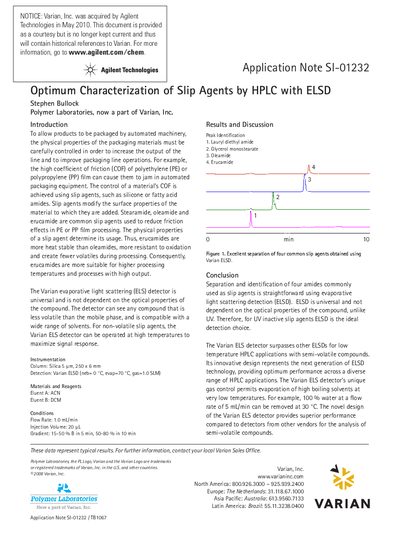
The note details a specific analytical method using a Varian ELSD detector, highlighting its universality and independence from the optical properties of the compound. The instrumentation section specifies a Silica column and lists the eluents (ACN and DCM) and conditions used, including a flow rate of 1.0 mL/min and an injection volume of 20 pL. Results show the excellent separation of four common slip agents: lauryl diethyl amide, glycerol monostearate, oleamide, and erucamide. The conclusion emphasizes that ELSD is the ideal detection choice for UV-inactive slip agents and highlights the detector's superior performance in low-temperature HPLC applications.
| Column | Silica 5 jim, 250 x 6 mm |
|---|---|
| Detection | Varian ELSD (neb= 0 °C, evap=70 °C, gas=1.0 SLM) |
| Flow Rate | 1.0 mL/min |
| Injection Volume | 20 pL |
| Gradient | 15-50 % Bin 5 min, 50-80 % in 10 min |
Common slip agents include stearamide, oleamide, and erucamide.
ELSD is preferred because it is universal and not dependent on the optical properties of the compound, unlike UV.
Erucamides are more suitable for higher processing temperatures due to their heat stability.