
This is an application note about the separation of ginseng root constituents by HPLC.
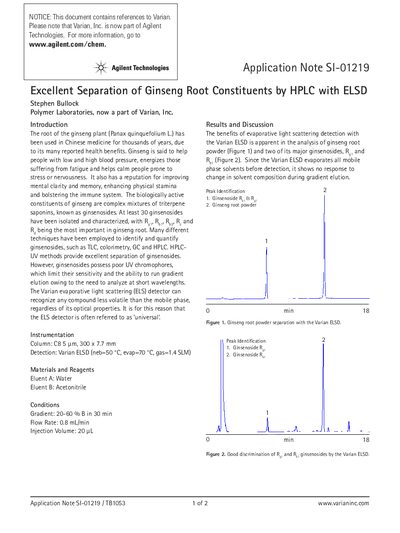
This document details the analysis of ginseng root constituents, specifically ginsenosides Rg1 and Rb1, using High-Performance Liquid Chromatography (HPLC) coupled with an evaporative light scattering (ELS) detector. The text highlights that while HPLC-UV methods provide good separation, ginsenosides have poor UV chromophores, limiting sensitivity and gradient elution capabilities. The Varian ELSD is presented as a universal detector capable of recognizing these compounds regardless of their optical properties.
| Column | C8 5 µm, 300 x 7.7 mm |
|---|---|
| Detection Nebulizer Temperature | 50 °C |
| Detection Evaporator Temperature | 70 °C |
| Flow Rate | 0.8 mL/min |
| Injection Volume | 20 µL |
Ginsenosides possess poor UV chromophores, which limit sensitivity and the ability to run gradient elution.
It can recognize any compound less volatile than the mobile phase, regardless of its optical properties.