
This application note describes a high resolution method for analyzing triglycerides in vegetable oils. The method uses the Varian evaporative light scattering detector, which has good selectivity and sensitivity for compounds such as triglycerides that lack UV chromophores.
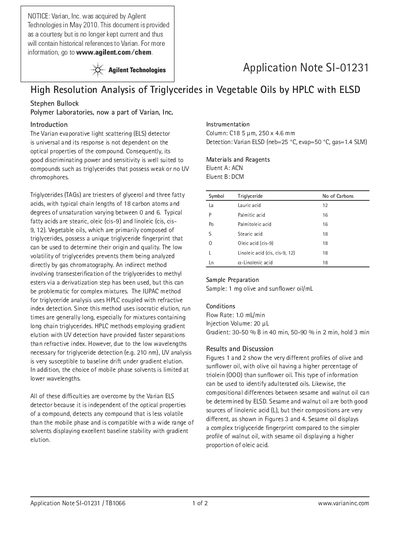
This document details a method for analyzing triglycerides in vegetable oils using High-Performance Liquid Chromatography (HPLC) coupled with an evaporative light scattering detector (ELSD). The text explains that while traditional methods like gas chromatography or UV detection have limitations with triglycerides, the Varian ELS detector offers universal detection independent of optical properties, making it suitable for compounds with weak or no UV chromophores.
The note provides specific instrumental conditions, including a C18 column and a gradient elution method using acetonitrile and dichloromethane. It presents results comparing olive and sunflower oils, demonstrating the ability to identify adulteration and compositional differences based on triglyceride fingerprints. The document concludes by highlighting the superior performance of the Varian ELS detector for low-temperature HPLC applications involving semi-volatile compounds.
| Column | C18 5 um, 250 x 4.6 mm |
|---|---|
| Detection | Varian ELSD (neb=25 °C, evap=50 °C, gas=1.4 SLM) |
| Eluent A | ACN |
| Eluent B | DCM |
| Flow Rate | 1.0 mL/min |
| Injection Volume | 20 wL |
| Gradient | 30-50 % B in 40 min, 50-90 % in 2 min, hold 3 min |
The ELSD detector is universal and its response is not dependent on the optical properties of the compound, making it well suited for triglycerides that possess weak or no UV chromophores.
The low volatility of triglycerides prevents them being analyzed directly by gas chromatography.
The method uses Acetonitrile (ACN) as Eluent A and Dichloromethane (DCM) as Eluent B.