
This Application Note describes a method for determination of aminoglycoside antibiotics by HPLC with ELSD.
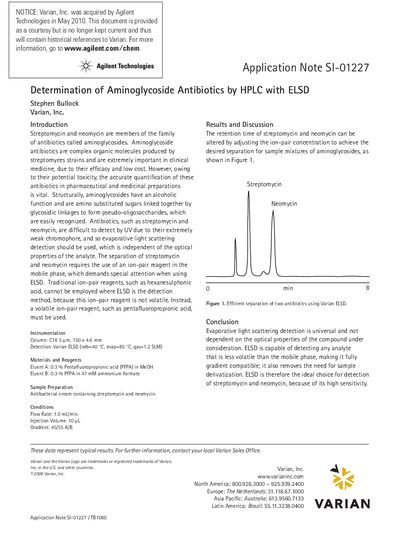
This document details a method for quantifying aminoglycoside antibiotics, specifically streptomycin and neomycin, in pharmaceutical preparations. Due to the weak chromophores of these compounds, traditional UV detection is ineffective; therefore, evaporative light scattering detection (ELSD) is recommended as it does not depend on optical properties.
The procedure utilizes a C18 column with an ion-pair reagent system compatible with ELSD. The method specifies the use of pentafluoropropionic acid in methanol and ammonium formate solutions to achieve efficient separation and detection.
| Column | C18 5 um, 150 x 4.6 mm |
|---|---|
| Detection Neb Temperature | 40 °C |
| Detection Evaporation Temperature | 85 °C |
| Gas Flow Rate | 1.2 SLM |
| Flow Rate | 1.0 mL/min |
| Injection Volume | 10 uL |
Aminoglycoside antibiotics have extremely weak chromophores, making them difficult to detect by UV; ELSD is independent of the optical properties of the analyte.
A volatile ion-pair reagent such as pentafluoropropionic acid must be used because traditional non-volatile reagents like hexanesulphonie acid are incompatible with ELSD.