
This application note describes a rapid and robust method for profiling carbohydrates in fruit juices using HPLC with ELSD.
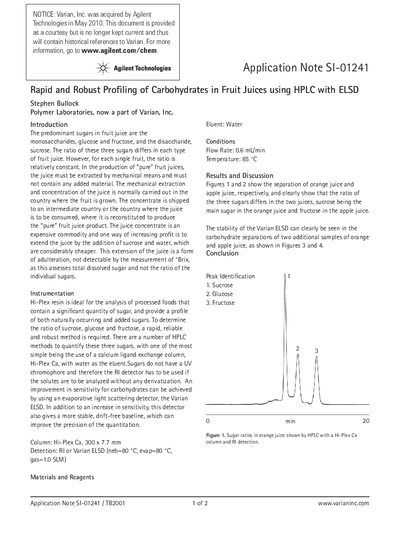
This document details a method for the rapid and robust profiling of carbohydrates, specifically glucose, fructose, and sucrose, in fruit juices. The method addresses the need to detect the adulteration of juice concentrates with cheaper sugars by analyzing the specific ratio of these sugars rather than just total dissolved solids.
| Column | Hi-Plex Ca, 300 x 7.7 mm |
|---|---|
| Detection | RI or Varian ELSD |
| Nebulizer Temperature | 80 °C |
| Evaporator Temperature | 80 °C |
| Gas Flow | 1.0 SLM |
| Eluent | Water |
| Flow Rate | 0.6 mL/min |
| Temperature | 85 °C |
The predominant sugars analyzed are the monosaccharides glucose and fructose, and the disaccharide sucrose.
The ELSD provides increased sensitivity and a more stable, drift-free baseline, which improves the precision of quantitation.
Analyzing the ratio of sugars helps detect the adulteration of juice concentrates with cheaper sucrose and water, which is not detectable by measuring total °Brix.