
This document describes the LC column and gradient elution method for Catechins Application 1999, and provides the names and relative peak areas of four peaks for peak identification.
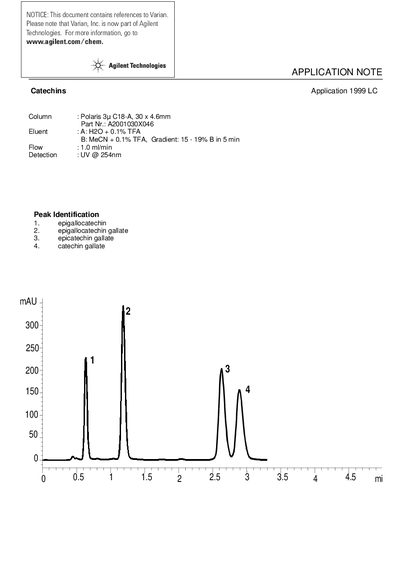
This document is an application note from Agilent Technologies regarding the analysis of catechins. It specifies the use of a Polaris 3 C18-A column with dimensions of 30 x 4.6mm and part number A2001030X046.
The procedure involves a gradient elution starting with 15% and ending at 19% acetonitrile (MeCN) over 5 minutes, with a flow rate of 21.0 ml/min. Detection is performed using UV at 254nm, identifying peaks for epigallocatechin, epigallocatechin gallate, epicatechin gallate, and catechin gallate.
| Column | Polaris 3 C18-A, 30 x 4.6mm |
|---|---|
| Part Number | A2001030X046 |
| Flow Rate | 21.0 ml/min |
| Detection | UV @ 254nm |
The identified peaks are epigallocatechin, epigallocatechin gallate, epicatechin gallate, and catechin gallate.
The analysis uses a Polaris 3 C18-A column with dimensions of 30 x 4.6mm.
The flow rate is set to 21.0 ml/min.
Detection is performed using UV at 254nm.