
This application note describes the method of using Polaris C18-A column to separate peptide standards under various solvent conditions. The method shows the retention time and selectivity of peptide standards with different side chains, which is useful for analyzing different peptides and protein samples.
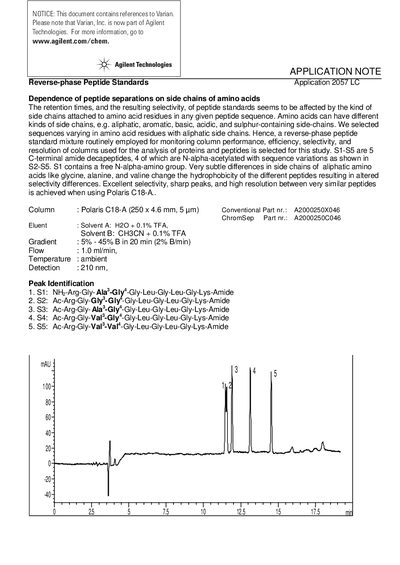
The document discusses how retention times and selectivity in reverse-phase peptide standards are affected by the types of side chains attached to amino acid residues. It highlights that subtle differences in aliphatic side chains, such as those found in glycine, alanine, and valine, alter hydrophobicity and result in different selectivity profiles.
| Column Part Number (Conventional) | A2000250X046 |
|---|---|
| Column Part Number (ChromSep) | A2000250C046 |
| Column Dimensions | 250 x 4.6 mm, 5 um |
| Flow Rate | 1.0 ml/min |
| Detection Wavelength | 210 nm |
The Polaris C18-A column is recommended as it achieves excellent selectivity, sharp peaks, and high resolution.
The document discusses aliphatic, aromatic, basic, acidic, and sulphur-containing side-chains.