
This application note describes a method for LC separation of hydrophobic penicillin-binding proteins using a Polaris 5µ C18-A column. The column provides excellent baseline resolution and can be used for dozens of cycles.
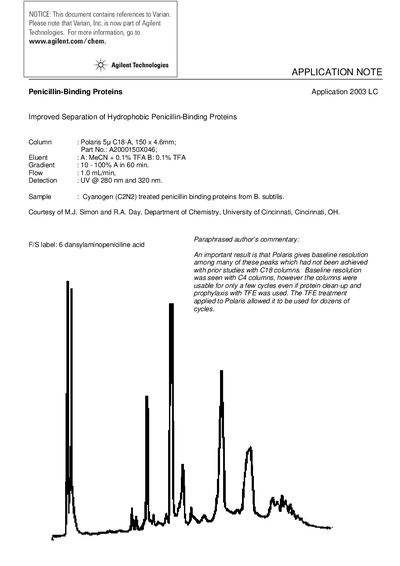
This document details an analytical method for separating hydrophobic penicillin-binding proteins from B. subtilis treated with cyanogen. The method utilizes a Polaris 5u C18-A column (Part No.: A2000150X046) with a specific gradient elution of acetonitrile and trifluoroacetic acid.
| Column | Polaris 5u C18-A, 150 x 4.6mm |
|---|---|
| Part Number | A2000150X046 |
| Eluent A | MeCN + 0.1% TFA |
| Eluent B | 0.1% TFA |
| Gradient | 110 - 100% A in 60 min. |
| Flow Rate | 21.0 mL/min |
| Detection Wavelengths | UV @ 280 nm and 320 nm. |
The sample used was cyanogen treated penicillin binding proteins from B. subtilis.
The flow rate is 21.0 mL/min.
Detection was performed using UV at 280 nm and 320 nm.