
UPG2118K is a 1.5W GaAs MMIC power amplifier developed by NEC Corporation. It uses E-mode FET technology, which has high efficiency and linearity. It is powered by a single +3.2V supply. It can be used in DCS/PCS1800, 915 and 2450 ISM bands.
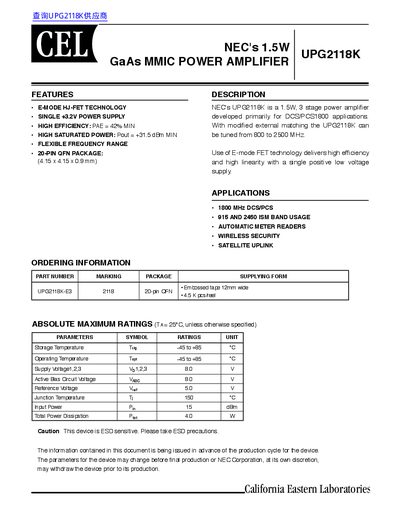
The CEL UPG2118K is a 1.5W, 3-stage power amplifier developed primarily for DCS/PCS1800 applications using NEC's E-MODE HJ-FET technology. It features high efficiency with a minimum PAE of 42% and high saturated power of +31.5 dBm minimum. The device operates with a single +3.2V power supply and is housed in a 20-pin QFN package measuring 4.15 x 4.15 x 0.9 mm.
| Power Output | 1.5W |
|---|---|
| Stages | 3 stage |
| Technology | E-MODE HJ-FET |
| Supply Voltage | +3.2V |
| Frequency Range | 800 to 2500 MHz |
| Package Type | 20-PIN QFN |
| Package Dimensions | 4.15 x 4.15 x 0.9 mm |
| Min Power Added Efficiency | 42% |
| Min Saturated Power | +31.5 dBm |
| Operating Temperature | -45 to +85 °C |
The device is developed primarily for DCS/PCS1800 applications, as well as 915 and 2450 ISM band usage, automatic meter readers, wireless security, and satellite uplink.
The minimum power added efficiency (PAE) is 42%.
The maximum supply voltage is 8.0V.
The maximum junction temperature is 150 °C.