
NEC's NE6510179A is a GaAs HJ-FET designed for medium power mobile communications, Fixed Wireless Access, ISM, WLL, PCS, IMT-2000, and MMDS transmitter and subscriber applications. It is capable of delivering 1.8 watts of output power at 3.5V and 3 watts of output power at 5V with high linear gain, high efficiency, and excellent linearity. Reliability and performance uniformity are assured by NEC's stringent quality and control procedures.
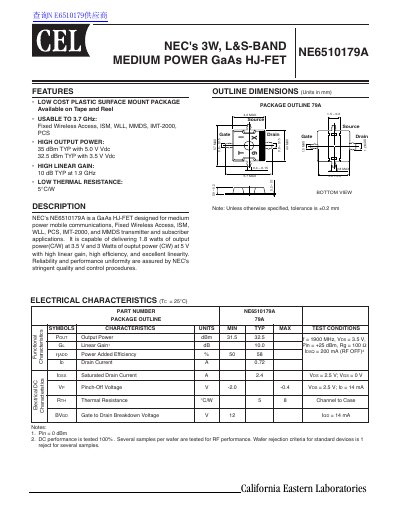
The CEL NE6510179A is a GaAs HJ-FET designed for medium power applications in mobile communications, Fixed Wireless Access, ISM, WLL, PCS, IMT-2000, and MMDS. It is capable of delivering 3 Watts of output power (CW) at 5 V with high linear gain and efficiency. The device is available in a low-cost plastic surface mount package and is usable up to 3.7 GHz.
| Output Power (CW) at 5V | 3 Watts |
|---|---|
| Output Power (CW) at 3.5V | 1.8 Watts |
| Linear Gain (Typical) at 1.9 GHz | 10 dB |
| Usable Frequency Range | Up to 3.7 GHz |
| Thermal Resistance | 5°C/W |
| Drain to Source Voltage (Max) | 8 V |
| Channel Temperature (Max) | 150 °C |
It is designed for medium power mobile communications, Fixed Wireless Access, ISM, WLL, PCS, IMT-2000, and MMDS transmitter and subscriber applications.
The device is usable up to 3.7 GHz.
The typical linear gain is 10 dB at 1.9 GHz.