
cdc930 133-mhz differential clock synthesizer/driver for pc motherboards with 3-state outputs
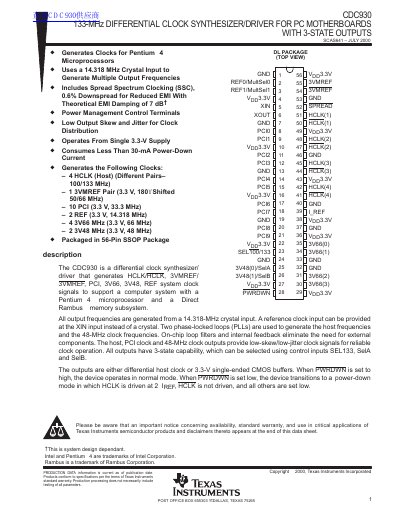
The CDC930 is a differential clock synthesizer and driver designed for PC motherboards supporting Pentium 4 microprocessors and Direct Rambus memory subsystems. It generates multiple output frequencies, including HCLK, 3VMREF, PCI, 3V66, 3V48, and REF, from a single 14.318 MHz crystal input. The device features Spread Spectrum Clocking (SSC) to reduce EMI and includes power management control terminals.
| Input Crystal Frequency | 14.318 MHz |
|---|---|
| Supply Voltage | 3.3 V |
| Power-Down Current | Less than 30 mA |
| Package Type | 56-Pin SSOP |
It generates HCLK (100/133 MHz), 3VMREF (50/66 MHz), PCI (33.3 MHz), REF (14.318 MHz), 3V66 (66 MHz), and 3V48 (48 MHz).
Yes, it includes Spread Spectrum Clocking (SSC) with 0.6% downspread for reduced EMI.
Output frequency selection is accomplished with the corresponding setting for the SEL100/133 control input.