
The CDCR61A is an independent crystal clock generator from Texas Instruments. It supports 400MHz differential clock signal output, and provides single-ended 1/2 clock signal output. It can be selected to output 300MHz or 400MHz clock signal.
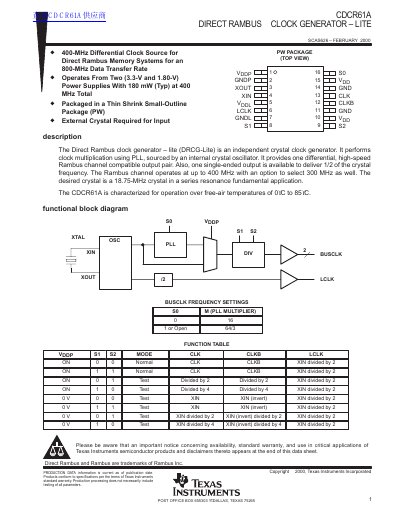
The CDCR61A is an independent crystal clock generator designed for Direct Rambus Memory Systems. It performs clock multiplication using a Phase-Locked Loop (PLL) sourced by an internal crystal oscillator, providing one differential high-speed output pair compatible with the Rambus channel and one single-ended output delivering half the crystal frequency.
The device operates at data transfer rates up to 800 MHz (400 MHz clock) and supports frequencies of 300 MHz or 400 MHz. It requires an external 18.75-MHz series resonance fundamental crystal for input and is characterized for operation over free-air temperatures ranging from 0°C to 85°C.
| Maximum Clock Frequency | 400 MHz |
|---|---|
| Data Transfer Rate | 800-MHz |
| Operating Temperature Range | 0°C to 85°C |
| Input Crystal Frequency | 18.75 MHz |
The Rambus channel operates at up to 400 MHz with an option to select 300 MHz as well.
An external 18.75-MHz series resonance fundamental crystal is required.