
The FDD8444 is an N-channel power MOSFET manufactured by Fairchild Semiconductor Corporation. It features a typical rDS(on) of 4mΩ, a typical Qg(10) of 89nC, low Miller charging and low Qrr body diode characteristics, and has passed AEC Q101 and RoHS certification. It can be applied to automotive engine control, powertrain management, solenoid and motor drivers, electronic transmissions, distributed power architectures and VRMs, and 12V systems as the main switch.
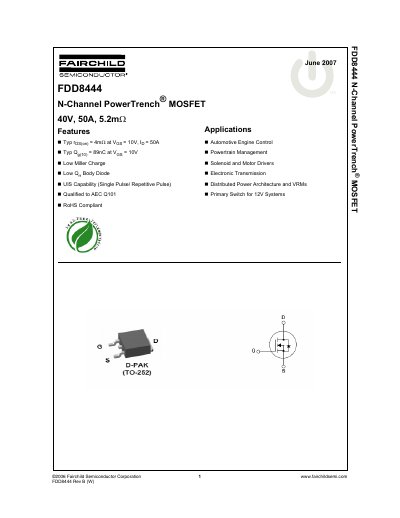
The document is a technical datasheet for the FDD8444, a 40V, 50A N-Channel PowerTrench MOSFET designed for automotive applications such as engine control and powertrain management. Key features include low on-resistance (5.2mΩ typical), low gate charge, and UIS capability.
| Drain to Source Voltage | 40 V |
|---|---|
| Gate to Source Voltage | +20 V |
| Continuous Drain Current | 50 A |
| On Resistance | 5.2 mΩ |
| Package Type | TO-252AA |
| Operating Temperature | -55 to +175 °C |
The drain to source voltage is rated at a maximum of 40 V, and the gate to source voltage must not exceed +20 V.
This MOSFET is designed for automotive engine control, powertrain management, solenoid and motor drivers, and electronic transmission systems.