
The use of a column packing having reduced particle size can improve efficiency of a separation or, alternatively, increase loading capacity.
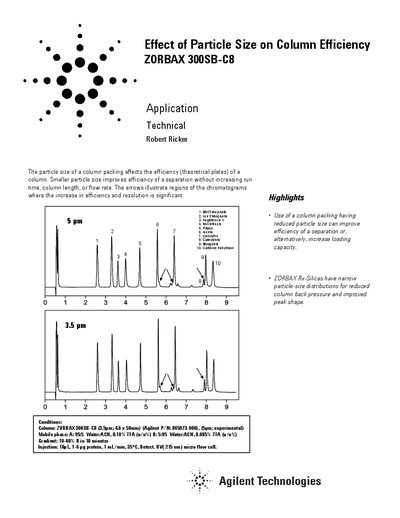
This document illustrates the effect of column packing particle size on chromatographic efficiency, specifically using the Agilent ZORBAX 300SB-C8 column. It highlights that smaller particle sizes improve separation efficiency without increasing run time or flow rate.
The text details an application involving the analysis of ten different proteins, including Met Enkephalin and Insulin. The document specifies experimental conditions such as mobile phase composition, gradient settings, injection volume, and detection parameters used to demonstrate these improvements.
Smaller particle size improves the efficiency of a separation without increasing run time, column length, or flow rate.
The document lists Met Enkephalin, Leu ENkephalin, Angiotensin II, Neurotensin, RNase, Insulin, Lysozyme, Calmodulin, Myoglobin, and Carbonic Anhydrase.