
This article compares the stability test results of ZORBAX Eclipse XDB-C8 and Symmetry-C8. The ZORBAX particle technology results in an extremely strong and dense silica support that dissolves more slowly at higher pH than xerogel particles used in Symmetry column packings. The extra dense bonding of ZORBAX XDB-C8 helps to shield the silica support at intermediate pH and decreases loss of chromatographic performance compared to Symmetry C8. By combining dense, durable particles, extra-dense bonding, and double endcapping, ZORBAX Eclipse packings (e.g., XDB-C8) have increased lifetime compared to Symmetry columns.
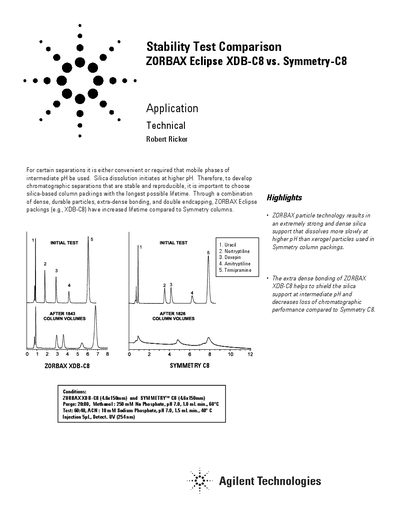
This technical application note compares the stability of Agilent ZORBAX Eclipse XDB-C8 columns against Waters Symmetry-C8 columns. The comparison focuses on silica-based column packings used for chromatographic separations where mobile phases of intermediate pH are required.
| Column Dimensions | 4.6x150mm |
|---|---|
| Purge Mobile Phase | 20:80, Methanol : 250 mM Na Phosphate, pH 7.0 |
| Test Mobile Phase | 60:40, ACN : 10 mM Sodium Phosphate, pH 7.0 |
| Flow Rate | 1.5 mL min. |
| Temperature | 40 C |
| Injection Volume | 5pL |
| Detection | UV (254 nm) |
ZORBAX particle technology uses a dense silica support that dissolves more slowly at higher pH than the xerogel particles used in Symmetry columns.
The extra dense bonding helps shield the silica support at intermediate pH and decreases the loss of chromatographic performance compared to Symmetry C8.