
This document highlights the advantages and characteristics of narrow bore and standard bore separation of polypeptides. It mentions that narrow bore columns require only 20% of the mobile phase and 1/3 of the sample volume compared to standard bore columns under sample-limited conditions. It also emphasizes the need to minimize extra-column volume for optimal efficiency when using narrow bore columns.
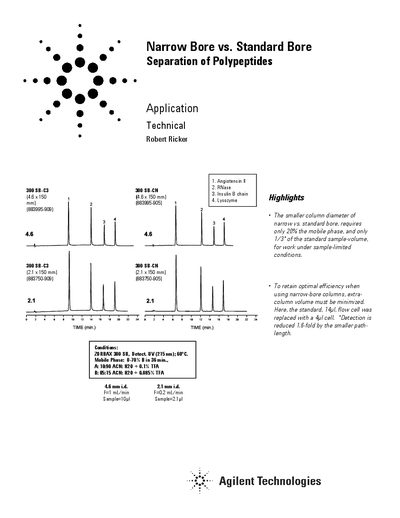
This document presents a technical comparison between narrow bore (2.1 mm i.d.) and standard bore (4.6 mm i.d.) ZORBAX 300 SB-C3 reversed-phase columns used for the separation of polypeptides, specifically Angiotensin II and Lysozyme. The analysis demonstrates that using a narrower column diameter reduces mobile phase consumption to approximately 20% of the standard while requiring only one-third of the sample volume.
The application details specific chromatographic conditions, including temperature (60°C), detection wavelength (UV at 215 nm), and gradient elution profiles. It further notes that optimal efficiency with narrow-bore columns requires minimizing extra-column volume by replacing the standard flow cell with a smaller 4 µL cell, which resulted in a 1.6-fold reduction in detection time.
| Column Diameter (Narrow Bore) | 2.1 mm i.d. |
|---|---|
| Mobile Phase Reduction | 20% of standard |
A smaller column diameter requires only 20% of the mobile phase needed for a standard bore.