
pH control is very important in providing separation stability for polar organic compounds that are basic or acidic. The short-chain SB-CN column is very stable under low pH conditions (e.g. pH 2.5).
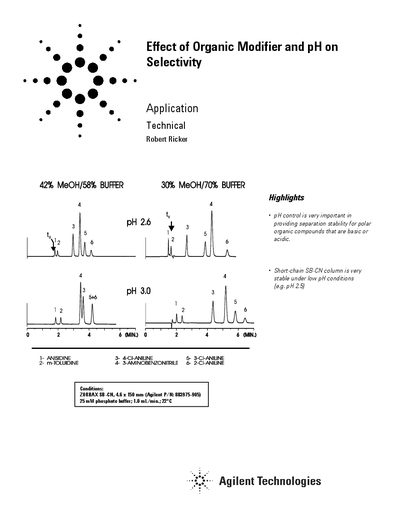
This document is an application note by Robert Ricker from Agilent Technologies regarding the effect of organic modifier pH on selectivity. It highlights that pH control is critical for providing separation stability for polar organic compounds that are basic or acidic. The note also notes that the short-chain SB-CN column is very stable under low pH conditions, such as pH 2.5.
| Column | ZORBAX SB-CN, 4.6 x 150 mm |
|---|---|
| Column Part Number | 883975-905 |
| Buffer Concentration | 25 mM phosphate buffer |
| Flow Rate | 1.0 mL/min. |
pH control is very important in providing separation stability for polar organic compounds that are basic or acidic.
Yes, the short-chain SB-CN column is very stable under low pH conditions, such as pH 2.5.