
This document describes the use of highly purified, less-acidic Type-B silica support (ZORBAX Rx-SIL) in reversed-phase separation of tricyclic antidepressants, which resulted in improved band shape and column efficiency for these basic drugs. Reduced retention for column with Type-B silica is due to lower surface area of its support.
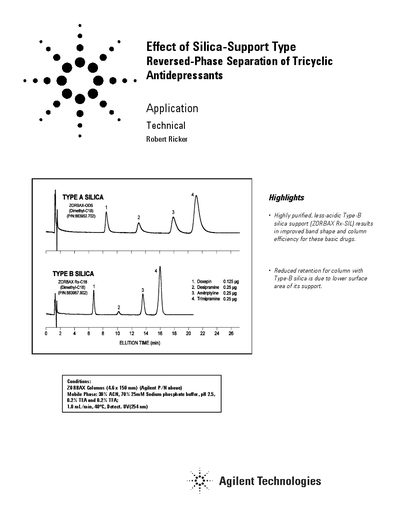
This application note investigates the impact of different silica support types on the chromatographic separation of four tricyclic antidepressant drugs: Doxepin, Desipramine, Amitriptyline, and Trimipramine. The study compares a standard Type A silica (ZORBAX ODS) with a highly purified, less-acidic Type B silica (ZORBAX Rx-SIL).
The test used 0.125 yg of Doxepin, 0.25 yg of Desipramine, 0.25 yg of Amitriptyline, and 0.25 yg of Trimipramine.
The procedure specifies a flow rate of 1.0 mL/min.