
This document describes an analytical method for the active ingredient in an agricultural fungicide formulation. Liquid chromatography is used to easily separate and detect the active ingredient without extensive sample preparation.
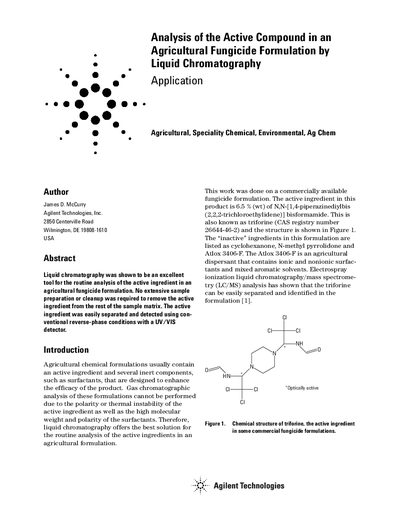
The document details a method for analyzing the active compound triforine (6.5 wt%) in a commercial agricultural fungicide formulation. The study demonstrates that electrospray ionization liquid chromatography/mass spectrometry is effective for this analysis without requiring extensive sample preparation or cleanup to remove inactive ingredients like surfactants.
The note presents experimental results using an Agilent 1100 Series LC System with a Zorbax XDB-C8 column. The analysis reveals that triforine elutes as two distinct chromatographic peaks due to its stereochemistry, specifically separating the meso compound from the enantiomers under conventional reverse-phase conditions.
A 10% (v/v) solution of the fungicide formulation was made in acetonitrile.