
The document describes the methods of isolating penicillins from the culture medium of certain fungi and synthesizing other penicillins through semisynthesis or precursor-indicated biosynthesis. Penicillin inhibits the polymerization of murin, which is responsible for the stability of the bacteria's cell wall. Due to the toxicity of many antibacterials, various countries regulate the level of antibacterial residues in agricultural, veterinary, dairy, and meat-based food products. The HPLC analysis in the document demonstrates the separation of four common antibacterial drugs with penicillin-like structure on an SB-C18 reversed phase column.
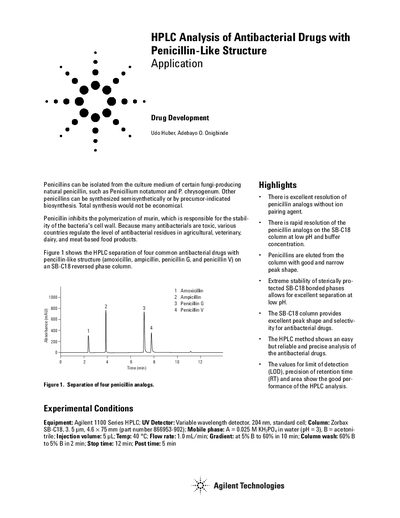
The document presents a High-Performance Liquid Chromatography (HPLC) method designed to separate and analyze four common antibacterial drugs with penicillin-like structures: amoxicillin, ampicillin, penicillin G, and penicillin V. The analysis is performed using an SB-C18 reversed phase column under specific experimental conditions that ensure excellent resolution without the need for ion-pairing agents.
The method utilizes an Agilent 1100 Series HPLC system with a variable wavelength UV detector set at 204 nm. Key performance metrics, including limits of detection (LOD), retention time precision, and area precision, are provided in a table to demonstrate the reliability and accuracy of the analysis.
| Column | Zorbax SB-C18, 3.5 µm, 4.6 x 75 mm |
|---|---|
| Detector wavelength | 204 nm |
| Injection volume | 5 µL |
| Temperature | 40 °C |
| Flow rate | 1.0 mL/min |
The method analyzes amoxicillin, ampicillin, penicillin G, and penicillin V.
No, the method provides excellent resolution without using an ion-pairing agent.